

What are the characteristics of the ultrasonic knife transducer
Release time:
2021-12-17
Source:
Ultrasonic scalpel transducer is used to achieve different forms of energy conversion instruments or devices, generally referred to as the transducer. For example, the conversion between electrical energy and acoustic energy, electrical energy and magnetic energy, electrical energy and mechanical energy, electrical energy and light energy, electrical energy and chemical energy, electrical energy and thermal energy, etc. Sonar transducers, hydroacoustic transducers and electroacoustic transducers are commonly referred to as transducers in the hydroacoustic field.
ultrasonic knife transducerIs used to achieve different forms of energy conversion instruments or devices, generally referred to as the transducer. For example, the conversion between electrical energy and acoustic energy, electrical energy and magnetic energy, electrical energy and mechanical energy, electrical energy and light energy, electrical energy and chemical energy, electrical energy and thermal energy, etc. Sonar transducers, hydroacoustic transducers and electroacoustic transducers are commonly referred to as transducers in the hydroacoustic field.
The performance of the ultrasonic knife transducer is designed and realized in manufacturing, which is reflected in the application of thermal enterprises. The design of the ultrasonic blade transducer includes:(1) acoustic index design;(2) manufacturing process design;(3) reliability design;(4) stability design;(5) consistency design. The purpose of ultrasonic knife transducer design is to meet the needs of the heat meter system in the working environment, specifically, to receive the transducer at the working frequency point to obtain a high amplitude, stable waveform signal waveform.
The main technical indexes of ultrasonic heat meter transducer are working frequency band, transmitting voltage sensitivity, receiving voltage sensitivity, directional opening angle, insulation resistance and working frequency impedance. There is a certain mutual influence between these technical parameters, and a good balance should be found in the design.
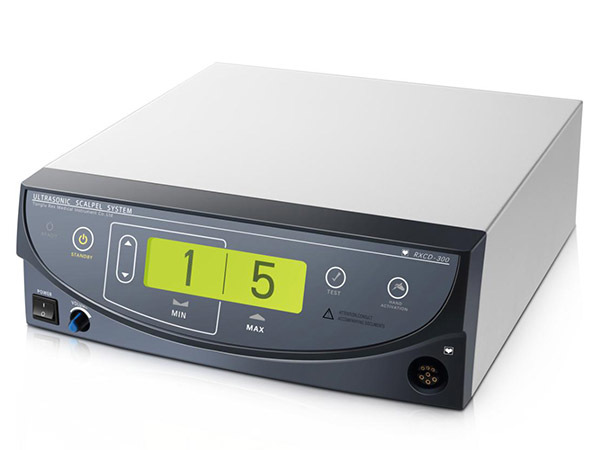
The piezoelectric element is the core of the piezoelectric ultrasonic blade transducer. There are many kinds of piezoelectric elements: piezoelectric single crystals, piezoelectric ceramics, PVDF, piezoelectric composites, glass ceramics, relaxor ferroelectric single crystals, etc. Among them, piezoelectric ceramics have many advantages, such as low price, excellent piezoelectric performance, wide variety, high mechanical strength, easy molding, mature technology, stable performance and so on. At present, it occupies a major position in the field of piezoelectric transducers.
At present, according to the working frequency of the ultrasonic heat meter transducer, the selected piezoelectric element mainly works in the thickness mode. The transducer is composed of supporting base, piezoelectric ceramic and radiation surface. It seems simple, but there are still many design and technical problems to solve.
When ultrasonic knife transducers are used in pairs, in order to obtain a good resonance waveform, it is necessary to find the frequency point between the transmitting voltage sensitivity curve and the receiving sensitivity curve. This frequency point is determined by the operating frequency, which is usually slightly lower than the operating frequency. This is an important principle of transducer design! The design of the ultrasonic blade transducer is determined by the characteristics of the transceiver system, and there is a relationship between the operating frequency of the system, the operating frequency of the device and the frequency of the piezoelectric element. The design of the ultrasonic knife transducer is the design of the system, not the choice of the piezoelectric sheet.
Make a well-designedultrasonic knife transducerAchieving reliability, stability and consistency in mass production is an issue that manufacturers attach great importance to, which requires a lot of effort in the process.
Previous Page
Next Page
Related News
CONTACT US
Telephone:+86-057187799607
E-mail:info@hzrex.cn
Address: Room 6, 1, 206, 688 Binan Road, Changhe street, Binjiang District, Hangzhou
